The Trillion-Dollar Arbitrage - Why Distressed Affordable Housing is the Best Investment of the Decade
The Trillion-Dollar Arbitrage - Why Distressed Affordable Housing is the Best Investment of the Decade
Properties trading at $40K/door in markets where new construction costs $200K/door. This isn't a deal. It's a structural mispricing that won't last.
The Market That Everyone's Ignoring
While every real estate investor in America is chasing:
Luxury apartment conversions
STR properties in vacation markets
Fix-and-flip in hot suburbs
Class A multifamily in growth cities
A $1 trillion+ opportunity is sitting in plain sight, completely ignored.
Distressed affordable housing.
Not because it's a bad investment. Becausenobody's looking at it through the right lens.
The Numbers That Make No Sense
Let me show you the arbitrage:
New Construction Costs (per door):
Urban core markets: $350K-$500K/door
Suburban markets: $200K-$300K/door
Tertiary markets: $150K-$200K/door
Distressed Affordable Multifamily Acquisitions:
Nonprofit properties in foreclosure: $40K-$60K/door
LIHTC properties that can't refinance: $50K-$80K/door
Class C multifamily with deferred maintenance: $60K-$90K/door
You're buying at 20-30% of replacement cost.
In what world is that not an arbitrage opportunity?
Why Nobody Else Sees It
Traditional investors look at distressed affordable housing and see:
❌ Low rents (can't raise them much)
❌ Deferred maintenance (capital intensive)
❌ Difficult tenants (higher management costs)
❌ Regulatory constraints (LIHTC rules, affordability covenants)
❌ Low exit multiples (cap rates in the 7-9% range)
So they pass.
And that's whythe opportunity exists.
The Model They're Missing
What if you're not trying to maximize rents?
What if you're not trying to flip to another landlord?
What if your exit strategy isresident ownership?
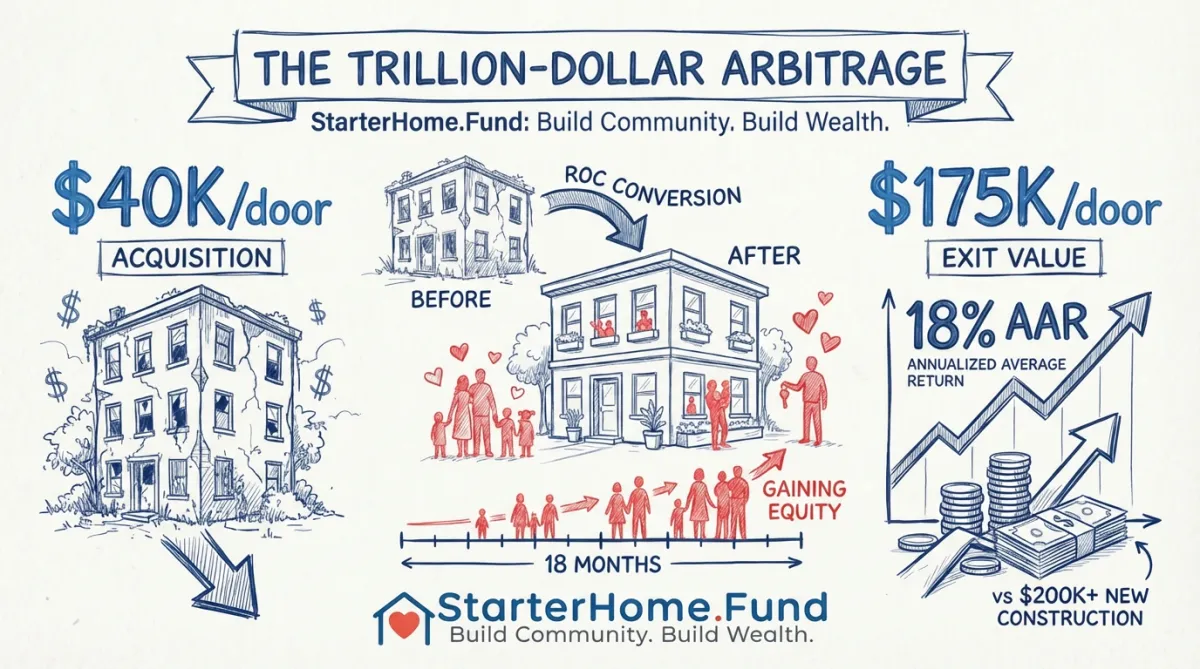
The ROC Conversion Model:
Step 1: Acquisition
Distressed 100-unit property in foreclosure
Acquisition price: $4.5M ($45K/door)
Built-in equity: Property worth $12-15M stabilized
Step 2: Stabilization
ROC conversion: Residents become equity owners
Deferred maintenance addressed (residents have skin in the game)
Zero turnover (owners don't move)
Property management costs drop (owners self-manage)
Step 3: Exit
Conservative valuation: $175/door = $17.5M
18-month hold
Returns: 18% AAR
But here's the key:Your exit isn't to another landlord charging max rents. Your exit is tothe residents as owners.
Why This Works Now (And Won't Forever)
Three forces are creating the opportunity:
1.Nonprofit Funding Collapse
DOGE cut 72% of affordable housing nonprofit funding this year.
Properties that were barely surviving on subsidies are now in foreclosure.90,000 LIHTC units are being lost annually.
These aren't bad properties. They're properties caught in a funding crisis.
Result:Acquisitions at $40K-$60K/door
2.Refinancing Cliff
Thousands of affordable housing properties financed at 3-4% rates between 2010-2021 are hitting their refinance windows.
New rates: 6-8%.
Many can't cover the debt service at current rents.
Result:Distressed sales below replacement cost
3.Median Income Crisis
Remember the data:
7.5M affordable units lost in 10 years
Median home requires $103K income (median earns $75K)
Price-to-income ratios at 5.7x
Traditional homeownership is dead for median earners.
But they still want ownership. They still want equity. They still want stability.
ROC conversions provide that.
The Competitive Moat
Here's why this opportunity has staying power:
Most investors can't do this deal.
Why?
They don't understand mission-aligned capital structures
Traditional lenders don't finance ROC conversions
You need access to CDFI loans, social impact capital, and patient money
They don't have the operational expertise
Converting to resident ownership isn't just paperwork
It's community organizing, legal structuring, and cultural change
They're chasing higher rents, not stable communities
Traditional model: maximize rent, minimize services
ROC model: stabilize community, preserve affordability
That complexity is your moat.
The Risk Profile
Let's be honest about the risks:
What could go wrong:
Deferred maintenance costs exceed projections (scope creep)
Resident conversion takes longer than 18 months (timeline risk)
Exit valuations come in below $175/door (market risk)
How we mitigate:
Conservative underwriting: Cap deferred maintenance at 25% of acquisition
Pre-conversion community buy-in: Start organizing before close
Multiple exit strategies: ROC preferred, but can also sell to mission-aligned operators
What's the worst case?
You bought at $45K/door in a market where new construction costs $200K/door and comparable sales are $120K+/door.
Even if the ROC conversion fails,you're sitting on 60%+ built-in equity.
The Scale of the Opportunity
How big is this market?
90,000 LIHTC units failing annually
Thousands of nonprofit properties in foreclosure
100,000+ Class C multifamily units trading below replacement cost
At $50K/door average acquisition, that's$10+ billion in annual deal flow.
And almost nobody is competing for it.
Why It Won't Last
This opportunity has a shelf life.
Eventually:
Social impact capital will wake up to the returns
Traditional PE will figure out the ROC model
Policy will change to rescue failing nonprofits
Replacement cost gap will narrow
The window is now.
Properties are in foreclosuretoday. Nonprofits are losing fundingtoday. The refinancing cliff is happeningnow.
By 2027-2028, this arbitrage will be widely known. Cap rates will compress. Acquisition prices will rise.
First movers will build portfolios at $40K-$60K/door.
Late movers will pay $90K-$120K/door for the same properties.
The Bottom Line
Distressed affordable housing is trading at20-30% of replacement costin markets where demand is exploding and supply is shrinking.
Everyone else is chasing deals in competitive markets with thin margins.
We're buying properties at $45K/door and exiting at $175/door.
We're delivering 18% AAR while preserving affordable housing and creating resident ownership.
And we're doing it in a market wherealmost nobody is competing.
That's not a deal. That's astructural arbitrage.
And it won't last forever.
👉Join the investors who see what others miss.
Earn 18% AAR in Distressed Affordable Housing →
Data Source: Harvard Joint Center for Housing Studies, State of the Nation's Housing 2025